
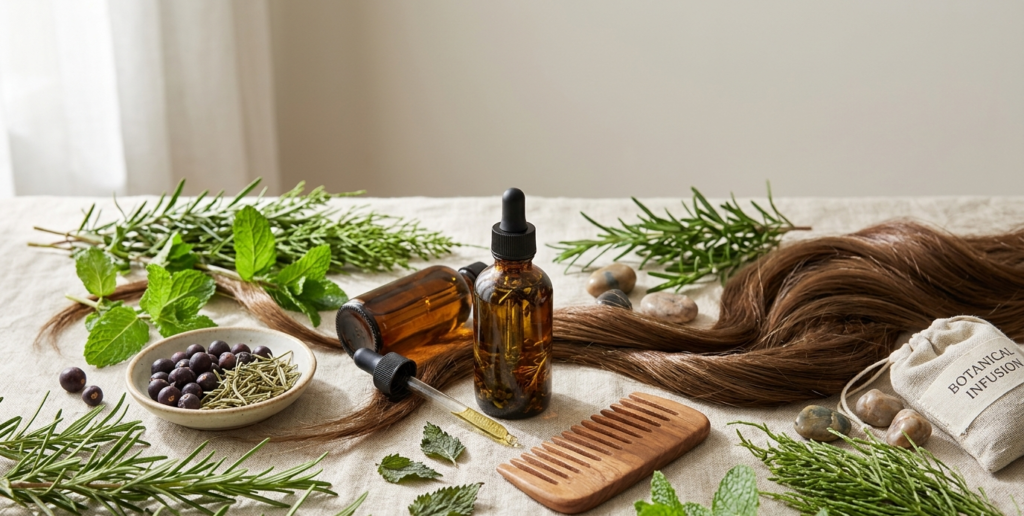
If you’ve been on TikTok or Instagram lately, you’ve probably seen the rosemary water trend everywhere. Influencers are ditching expensive hair serums for a simple herb rinse, and the before/after results are genuinely impressive.
But does rosemary (or any herb) actually grow hair? Or is this just another viral wellness fad?
Here’s what the science actually says about herbs for hair growth — plus 4 more botanicals that work just as well.
The Hair Growth Reality Check
First, let’s be honest: No herb will regrow a completely bald scalp. If you have severe hair loss from genetics (male/female pattern baldness) or medical conditions, you need to see a dermatologist.
But herbs can help with:
- Thinning hair and reduced density
- Slow hair growth
- Hair breakage and weakness
- Scalp inflammation causing shedding
- Stress-related hair loss
Think of herbs as hair optimizers — they create the healthiest possible conditions for growth, but they can’t override genetics.
Now, let’s look at the herbs that actually have research backing.
1. Rosemary — The Viral Hair Hero
Best for: Thinning hair, slow growth, scalp circulation
Rosemary oil has become the internet’s favorite hair hack, and for once, the hype matches the science.
The Research
A 2015 study compared rosemary oil to minoxidil (Rogaine) for androgenetic alopecia (pattern baldness). After 6 months:
- Both groups showed significant hair growth
- Rosemary worked as well as minoxidil
- Rosemary caused less scalp itching
Another study showed rosemary extract increased hair count by 22.4% after 6 months of consistent use.
How It Works
Rosemary contains compounds (carnosic acid, rosmarinic acid, ursolic acid) that:
- Improve blood circulation to hair follicles
- Reduce DHT (the hormone that causes pattern baldness)
- Have anti-inflammatory effects on the scalp
- Stimulate nerve endings that promote hair growth
How to Use Rosemary
Rosemary water hair rinse (the TikTok method):
- Boil 2-3 fresh rosemary sprigs (or 2 tbsp dried) in 2 cups water
- Simmer 15 minutes, let cool completely
- Strain and pour into spray bottle
- Spray on scalp after washing, massage in, don’t rinse
- Use 3-4x per week
Rosemary oil scalp treatment:
- Mix 5-10 drops rosemary essential oil with 1 tbsp carrier oil (jojoba, coconut)
- Massage into scalp for 5 minutes
- Leave on 30+ minutes (or overnight)
- Shampoo out
- Use 2-3x per week
Results timeline: Most people see reduced shedding within 4-6 weeks, visible growth within 3-6 months.
2. Peppermint Oil — The Growth Accelerator
Best for: Stimulating new growth, hair thickness
Peppermint oil doesn’t get as much hype as rosemary, but the research is arguably even stronger.
The Research
A 2014 animal study compared peppermint oil to minoxidil and saline. After 4 weeks:
- Peppermint oil produced MORE hair growth than minoxidil
- Increased hair follicle number and depth
- Promoted transition to active growth phase
Human studies are limited, but anecdotal evidence is strong, and the mechanism makes sense.
How It Works
The menthol in peppermint oil:
- Increases blood flow to scalp (you feel the tingling!)
- Dilates blood vessels around follicles
- Extends the anagen (growth) phase of hair
- Has antimicrobial properties for scalp health
How to Use Peppermint
Scalp treatment:
- Mix 3-5 drops peppermint essential oil with 1 tbsp carrier oil
- Massage into scalp thoroughly
- Leave on 20-30 minutes
- Shampoo out well
- Use 2-3x per week
Warning: Peppermint oil is strong — you’ll feel intense tingling. Start with fewer drops and work up. Never use undiluted on scalp.
Results timeline: Some people notice faster growth within 2-3 months of consistent use.
3. Saw Palmetto — The DHT Blocker
Best for: Pattern baldness (androgenetic alopecia), thinning
Saw palmetto is the herbal equivalent of finasteride (Propecia) — it blocks DHT, the hormone that shrinks hair follicles in pattern baldness.
The Research
Multiple studies show saw palmetto increases hair growth in people with androgenetic alopecia:
- One study showed 60% of men had hair growth improvement
- Another study found 38% increase in hair count after 4 months
- Works better when combined with other treatments
It’s not as strong as prescription finasteride, but it has far fewer side effects.
How It Works
Saw palmetto inhibits 5-alpha reductase, the enzyme that converts testosterone to DHT. Less DHT = less follicle shrinkage = more hair.
How to Use Saw Palmetto
Oral supplement: 320mg standardized extract daily (85-95% fatty acids and sterols)
Topical: Some people add saw palmetto extract to rosemary or peppermint oil treatments
Results timeline: 4-6 months for visible results. This is a slow burn, not a quick fix.
Important: Saw palmetto can affect hormones. Consult your doctor if you’re on hormone-related medications or have hormone-sensitive conditions.
Learn more about Saw Palmetto →
4. Nettle Leaf — The Anti-Shedding Herb
Best for: Excessive shedding, thinning, scalp inflammation
Stinging nettle is less trendy than rosemary, but it’s one of the most effective herbs for reducing hair loss.
The Research
Nettle contains compounds that:
- Block DHT (like saw palmetto, but milder)
- Reduce inflammation in hair follicles
- Are rich in silica, iron, and vitamins that support hair structure
Studies show nettle extract reduces hair shedding and improves hair density when used consistently.
How It Works
Nettle is rich in:
- Beta-sitosterol (DHT blocker)
- Silica (strengthens hair structure)
- Iron (prevents shedding from deficiency)
- Antioxidants (protect follicles from damage)
How to Use Nettle
Nettle tea rinse:
- Steep 2-3 tbsp dried nettle leaf in 2 cups hot water for 15 minutes
- Cool completely, strain
- Pour over scalp after washing, massage in
- Don’t rinse out
- Use 3-4x per week
Oral supplement: 300-600mg nettle leaf extract daily
Results timeline: Reduced shedding within 4-8 weeks, visible thickness improvement in 3-4 months.
Learn more about Nettle Leaf →
5. Horsetail (Silica) — The Strengthener
Best for: Brittle, breaking hair, weak strands, slow growth
Horsetail doesn’t stimulate new growth like rosemary or peppermint, but it makes existing hair significantly stronger and less prone to breakage.
The Research
Horsetail is one of the richest plant sources of silica (up to 10% by weight). Silica is essential for:
- Collagen production (hair structure)
- Keratin synthesis (hair protein)
- Hair elasticity and strength
Studies show silica supplementation improves hair thickness, reduces breakage, and may accelerate growth.
How It Works
Silica:
- Strengthens hair shaft structure
- Improves hair elasticity (less breakage)
- May increase diameter of individual hairs
- Supports collagen in the scalp
How to Use Horsetail
Oral supplement: 300-500mg horsetail extract daily (look for standardized silica content)
Topical: Can be added to hair rinses (less effective than oral)
Combo: Many people combine horsetail (internal) with rosemary (topical) for comprehensive results
Results timeline: Stronger, less breakage-prone hair within 6-8 weeks. Visible thickness takes 3-4 months.
Warning: Don’t use horsetail long-term (6+ months continuously) without breaks. It can deplete thiamine (vitamin B1).
The Best Herb Combinations for Hair Growth
Don’t just use one herb — stack them strategically:
The Growth Stack (for thinning/slow growth)
- Morning: Saw palmetto 320mg (oral)
- Evening: Nettle tea or supplement 300mg (oral)
- 3x per week: Rosemary water rinse (topical)
The Thickness Stack (for weak, breaking hair)
- Daily: Horsetail 500mg (oral)
- 3x per week: Rosemary + peppermint oil scalp massage (topical)
The Scalp Health Stack (for inflammation, dandruff)
- 3-4x per week: Rosemary water rinse (topical)
- 2x per week: Tea tree + peppermint oil treatment (topical)
- Daily: Nettle tea (oral)
How Long Before You See Results?
Realistic timeline:
- 4-6 weeks: Less shedding, healthier scalp
- 8-12 weeks: New baby hairs along hairline
- 3-6 months: Visible increase in density and thickness
- 6-12 months: Maximum results
Hair grows slowly — about 1/2 inch per month. Be patient and consistent.
What Doesn’t Work (Despite the Hype)
Onion juice: Popular on the internet, minimal research. Smells terrible, questionable results.
Rice water: Traditional remedy with weak modern evidence. May coat hair and make it appear thicker temporarily, but doesn’t stimulate growth.
Castor oil: Very popular, but there’s almost no scientific evidence it grows hair. It’s a great moisturizer, but not a growth stimulant.
Aloe vera: Soothes scalp, good for dandruff, but doesn’t promote hair growth.
Stick to the herbs with actual research backing: rosemary, peppermint, saw palmetto, nettle, horsetail.
Important Safety Notes
Pregnancy/breastfeeding: Avoid saw palmetto, peppermint oil, and rosemary essential oil (tea/rinse is fine).
Hormone-sensitive conditions: Use saw palmetto and nettle with caution — they affect hormones.
Scalp sensitivity: Always patch test essential oils. Dilute properly.
Existing hair loss medications: If you’re on minoxidil or finasteride, you can add herbs, but don’t stop prescription meds without talking to your doctor.
When to see a doctor: If you’re experiencing sudden, severe hair loss, bald patches, or hair loss with scalp pain/itching, see a dermatologist. This could indicate an underlying medical condition.
The Bottom Line
Herbs won’t cure genetic baldness, but they can significantly improve hair density, reduce shedding, and create optimal conditions for growth.
The best herbs for hair growth:
- Rosemary — best all-rounder, works as well as minoxidil
- Peppermint — strongest growth stimulation
- Saw palmetto — blocks DHT for pattern baldness
- Nettle — reduces shedding and inflammation
- Horsetail — strengthens and thickens existing hair
Start with rosemary water rinses 3-4x per week. It’s cheap, easy, and backed by solid research. Add other herbs based on your specific hair concerns.
Give it 3-6 months of consistent use before deciding if it works. Hair growth takes time — there are no overnight miracles.
Related herbs:
