
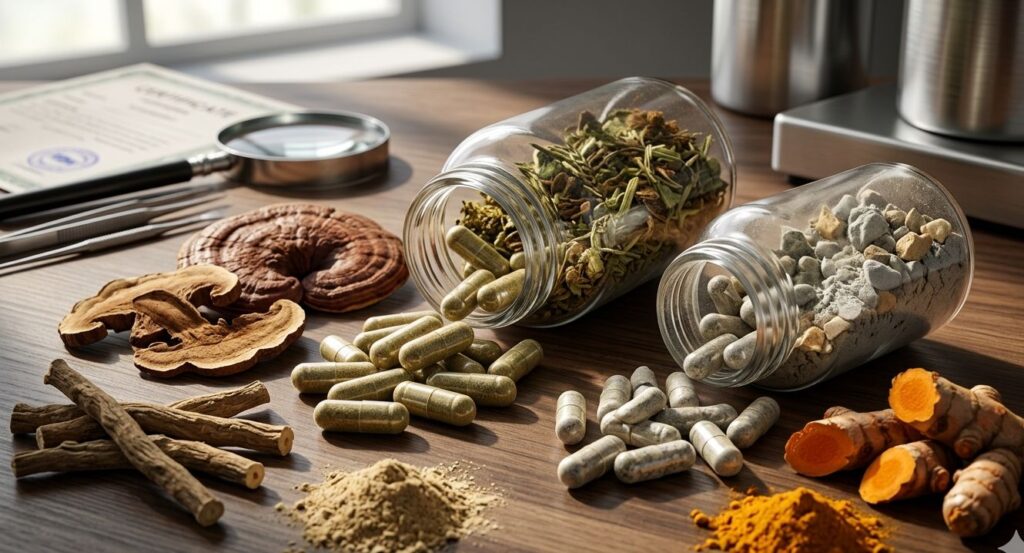
You buy what you think is ashwagandha. You take it for months. Nothing happens.
It’s not because ashwagandha doesn’t work. It’s because what you bought probably isn’t ashwagandha.
Welcome to the herbal supplement industry’s dirty secret: 42% of herbal medicine products face standardization issues. Many are:
- Mislabeled (contains different herbs entirely)
- Underdosed (active compounds at 10% of labeled amount)
- Contaminated (heavy metals, pesticides, mold)
- Mixed with fillers and cheap ingredients
- Not even plants (sometimes rocks and dirt)
Here’s how to actually buy real herbs.
The Problem: Why Quality Is Terrible
Lack of Regulation
Unlike pharmaceuticals, supplements don’t need FDA approval before hitting shelves. The FDA only acts after a product causes harm.
This means:
- Any company can package anything and call it ashwagandha
- No mandatory testing for purity or potency
- No required standardization of active compounds
- Quality control is entirely voluntary
Economic Incentives
Herb suppliers make more money by:
- Using cheaper species (wrong plant entirely)
- Using fillers (rice flour, talc, weeds)
- Extracting less herb per capsule (cost reduction)
- Not testing for contamination (saves money)
The supplement industry is worth $171+ billion. Margins are thin. Shortcuts are everywhere.
Supply Chain Opacity
Herbs are sourced globally:
- Ashwagandha from India
- Ginseng from Korea
- Turmeric from Indonesia
- Reishi from China
Many Western supplement companies never see the farms. They buy from middlemen, who buy from other middlemen. By the time it reaches you, nobody knows what actually happened to the plant.
What’s Actually in Your Supplement? (Real Examples)
The Ashwagandha Case Study
A 2021 analysis of 78 ashwagandha products found:
- 35% had insufficient withanolide content (the active compound)
- Some contained only 10% of labeled amount
- One product contained mostly starch and rice flour
- Heavy metals detected in some samples
People took them for months. No results. Not because ashwagandha doesn’t work—because what they took wasn’t ashwagandha.
The Herbal Adulterants Problem
Studies consistently find supplements mislabeled with:
- Completely different herbs
- Allergenic herbs (when labeled as something else)
- Prescription drugs secretly added
- Heavy metals
- Pesticides banned in the US (but used in other countries)
One notorious case: “St. John’s Wort” products that contained actual St. John’s Wort mixed with cheaper herbs. When tested, 60% had less St. John’s Wort than labeled.
Red Flags: What to Avoid
🚩 Ultra-Cheap Prices
Example: Ashwagandha 500mg capsules, 120 count, $5.99
If it’s cheaper than food, something’s wrong. Quality herbs cost money.
Fair pricing guide:
- Ashwagandha extract (standardized): $0.10-0.20 per capsule
- Turmeric extract (with black pepper): $0.08-0.15 per capsule
- Reishi dual-extract: $0.15-0.30 per capsule
If you’re paying less, you’re getting less.
🚩 No Standardization Listed
Bad label: “Ashwagandha root powder 500mg”
Good label: “Ashwagandha extract, standardized to 5% withanolides, 500mg”
Standardization means they tested and verified the active compound percentage. Without it, you don’t know what you’re getting.
🚩 No Third-Party Testing
Bad: Generic supplement with no testing information
Good: Label says “Third-party tested by NSF” or “USP verified” or “ConsumerLab tested”
Third-party testing means independent labs verified quality, purity, and potency.
🚩 Vague Sourcing
Bad: “Sourced from select locations worldwide”
Good: “Ashwagandha organically grown in Rajasthan, India” with certifications
If they won’t tell you where it comes from, something’s hidden.
🚩 “Proprietary Blend”
Red flag: “Proprietary herbal blend 750mg” (won’t say what’s in it or amounts)
This is often cheap herbs mixed with expensive-sounding ones. You can’t verify what you’re actually getting.
🚩 Plastic Packaging
Quality supplement companies use:
- Glass bottles (preserves potency)
- Dark glass (blocks light degradation)
- Airtight seals
Cheap plastic = oxidation, moisture damage, and degraded herbs.
🚩 No Expiration or Batch Info
Bad: No date on bottle
Good: Clear expiration date and batch number for traceability
Batch numbers let you track to the source if there’s a recall.
Green Flags: What to Look For
✅ Third-Party Testing Certifications
- NSF International — tests for purity, contaminants, label accuracy
- USP (U.S. Pharmacopeia) — verifies quality and potency standards
- ConsumerLab — independent testing lab, very thorough
- BPCI — Botanical Pharmacy Commission Index, high standards
These aren’t free. Companies that do it care about quality.
✅ Standardized Extracts
Look for:
- “Standardized to 95% curcuminoids” (turmeric)
- “Standardized to 5% withanolides” (ashwagandha)
- “Standardized to 25% shilajit” (fulvic/humic acid)
- “Dual-extracted” (contains both water and alcohol-soluble compounds)
Standardization = they tested it, verified potency, and adjusted extraction to guarantee results.
✅ Organic Certification
- USDA Organic seal = certified no synthetic pesticides
- Not perfect (organic farms can still have problems), but better
- Shows commitment to quality
✅ Heavy Metal Testing
Quality brands test for:
- Lead
- Cadmium
- Arsenic
- Mercury
Herbs from certain regions naturally contain some heavy metals. Testing and filtering removes them.
✅ Transparent About Sourcing
- “Ashwagandha grown in Rajasthan, India”
- “Turmeric sourced from certified organic farms in Indonesia”
- Maps or detailed sourcing information
This transparency suggests nothing to hide.
✅ Professional-Grade Brands
These are sold through practitioners (naturopaths, integrative MDs) and online, NOT in gas stations:
- Gaia Herbs — third-party tested, high quality
- Herb Pharm — small-batch, quality-focused
- Designs for Health — professional-grade, heavy testing
- Integrative Therapeutics — research-backed quality
- Wise Woman Herbals — small-batch, traditional methods
- Herb Formulations — standardized, tested
Vs. cheap brands:
- ❌ “Natural Plus” (generic)
- ❌ “Vitamin World” house brand (inconsistent quality)
- ❌ Unlabeled Amazon products
- ❌ Gas station supplements
✅ Bioavailability Enhancements
Quality turmeric includes:
- Black pepper (piperine) — increases absorption 2000%
Quality mushroom extracts use:
- Dual extraction — both water and alcohol soluble
These show the company understands how herbs work, not just that they work.
Where to Buy Real Herbs
Best: Professional/Specialty Retailers
- Naturopathic clinics — practitioner recommendations, quality brands
- Herb shops — staff actually know herbs, good sourcing
- Whole Foods (select brands) — higher standards than average
- VitaCost — online, third-party testing, good brands
- Vitabase — research-backed brands only
- iHerb — international quality brands
Medium: Reputable Online
- Amazon (carefully) — check brand reputation, certifications, reviews, batch dates
- Piping Rock — their own testing, reasonable prices
- Swanson — decent quality control, decent prices
- Mountain Rose Herbs — organic, tested, expensive but worth it
Avoid: Gas Stations, Dollar Stores, Random Amazon
If you can’t verify:
- Third-party testing
- Standardization
- Sourcing
- Expiration date
…don’t buy it.
How to Verify What You’re Buying
1. Check the Label Carefully
- Standardized to [active compound]%?
- Third-party tested?
- Expiration date legible?
- Batch number present?
- Transparent about ingredients?
2. Verify Online
Search: “[brand name] third party tested” or “[brand name] NSF USP”
Legit brands advertise their testing. No results? Suspicious.
3. Research the Company
- How long in business?
- Transparent sourcing?
- Responses to quality complaints?
- Any recalls?
4. Calculate Cost Per Dose
If ashwagandha extract is $0.10-0.20 per capsule and you’re paying $10 for 30 capsules ($0.33/capsule), you’re overpaying. But $3 for 30 capsules? You’re underpaying—probably not real.
5. Track Results
Take consistent dose for 2-4 weeks. Do you feel better?
- Yes = real herb, good quality
- No = either not real, not right dose, or not for your condition
- Switch brands and try again
The Economics of Quality
Why good herbs cost more:
- Sourcing: Paying farmers fairly for organic herbs
- Testing: Third-party lab analysis = expensive
- Standardization: Extracting to specific potency = skill and cost
- Storage: Glass bottles, proper packaging, cold storage = cost
- Labor: Actually trained staff, quality control
- Honesty: Not cutting corners with fillers or cheap substitutes
Good brands spend 30-50% on sourcing and testing. Cheap brands spend 10-15% and pocket the rest.
When you buy cheap supplements, you’re not getting a deal. You’re being scammed subtly.
Professional-Grade vs Consumer-Grade
Professional-Grade (Dispensary Only)
- Standardized extracts
- Heavy metal tested
- Third-party verified
- Better sourcing control
- Higher potency
- Cost: Higher but worth it
- Example: Designs for Health
Consumer-Grade (Health Store/Amazon)
- May or may not be standardized
- Limited testing information
- Marketing-heavy
- Less sourcing control
- Widely variable potency
- Cost: Lower but you get what you pay for
- Example: “Herbal Plus,” “Nature’s Way”
The Bottom Line
42% of herbal products have standardization issues because the industry has zero incentive to fix it. The FDA doesn’t mandate testing. Cheap brands undercut quality ones. Most consumers don’t know the difference.
Your safest bet:
- Buy professional-grade brands — through practitioners or verified online retailers
- Look for third-party testing — NSF, USP, or ConsumerLab certified
- Verify standardization — not “ashwagandha 500mg” but “ashwagandha standardized to 5% withanolides”
- Pay fair prices — cheap supplements are usually cheap for a reason
- Research the brand — transparent sourcing and testing matter
- Track results — if nothing happens after 4 weeks at the right dose, try a different brand
Quality herbs work. But you have to actually buy quality herbs.
Don’t let yourself be one of the people taking fake supplements, wondering why nothing changes.
Disclaimer: This information is for educational purposes. Always buy from reputable sources and consult healthcare providers before starting supplements.
Related articles:
