
If you’ve been scrolling TikTok or Instagram lately, you’ve probably seen #adaptogens trending everywhere. Wellness influencers are obsessed, supplement brands can’t keep them in stock, and your stressed-out friends are suddenly sipping “ashwagandha lattes.”
But what actually are adaptogens? And do they really work for stress, or is this just another wellness fad?
Here’s everything you need to know about adaptogens in 2026 — the science, the hype, and which ones actually deliver.
What Are Adaptogens?
Adaptogens are a specific class of herbs and mushrooms that help your body adapt to stress. Instead of sedating you (like sleep meds) or stimulating you (like caffeine), they work to bring your stress response back into balance — whether you’re overstimulated or exhausted.
Think of them as stress thermostats for your body. Too hot? They cool you down. Too cold? They warm you up.
The term “adaptogen” was coined by Russian scientist Nikolai Lazarev in 1947, but these herbs have been used in Traditional Chinese Medicine and Ayurveda for thousands of years.
How Do Adaptogens Work?
Adaptogens work primarily on your HPA axis (hypothalamic-pituitary-adrenal axis) — the system that controls your stress response.
When you’re stressed, your body releases cortisol. Short bursts are fine. Chronic high cortisol? That leads to:
- Anxiety and racing thoughts
- Fatigue and burnout
- Poor sleep
- Weakened immunity
- Weight gain (especially belly fat)
Adaptogens help regulate cortisol production, keeping it in a healthy range. They also support your adrenal glands, which produce stress hormones.
The result: You feel calmer under pressure, recover faster from stress, and maintain energy throughout the day.
The Top 5 Adaptogens for Stress (Backed by Science)
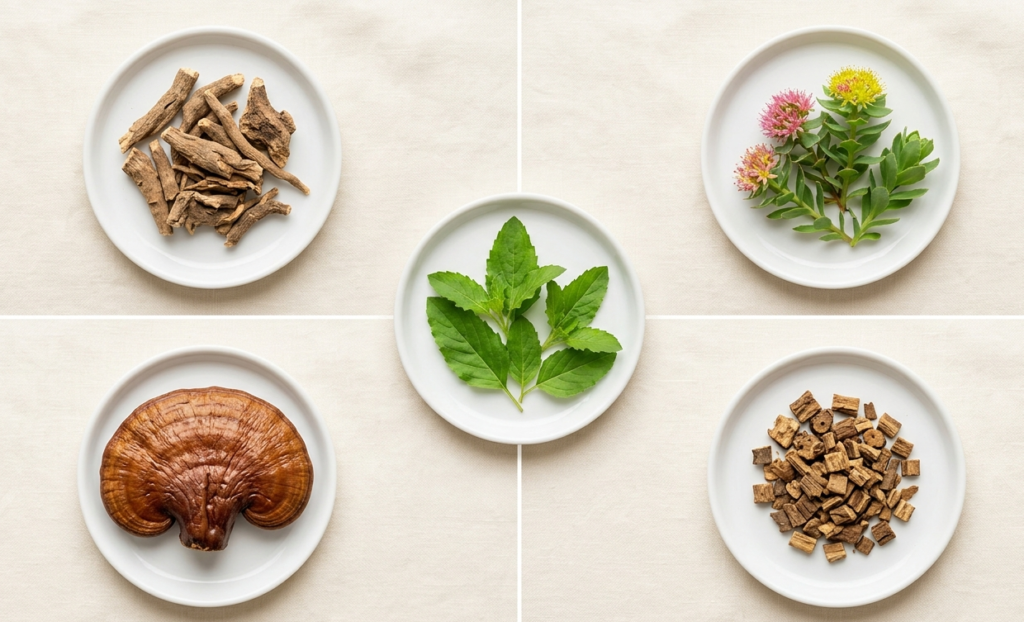
Not all adaptogens work the same way. Here are the best ones for stress, ranked by research quality and real-world effectiveness.
1. Ashwagandha — The Stress Reducer
Best for: Chronic stress, anxiety, sleep issues
Ashwagandha is the most researched adaptogen for stress. Multiple clinical trials show it significantly lowers cortisol levels and reduces anxiety symptoms.
How it feels: Calming and grounding. Takes the edge off stress without making you drowsy. Most people notice effects within 1-2 weeks.
Research score: 80/100 — excellent evidence
Dose: 300-600mg extract daily (standardized to withanolides)
When to take: Evening works best since it promotes relaxation
Learn more about Ashwagandha →
2. Rhodiola — The Energy Booster
Best for: Burnout, fatigue, mental fog
Rhodiola is the opposite of ashwagandha — it’s energizing rather than calming. Great for when stress leaves you exhausted and unfocused.
How it feels: Like a clean energy boost. Helps you power through demanding days without crashing.
Research score: 73/100 — good evidence
Dose: 200-600mg extract daily
When to take: Morning or early afternoon (may interfere with sleep if taken late)
3. Holy Basil (Tulsi) — The Mood Stabilizer
Best for: Emotional stress, mood swings, mental clarity
Holy Basil is sacred in Ayurveda for good reason — it balances mood and protects against stress-induced damage at the cellular level.
How it feels: Gently uplifting. Helps you stay emotionally steady during stressful periods.
Research score: 70/100 — good traditional and modern evidence
Dose: 300-600mg extract or 2-3 cups tea daily
When to take: Morning or mid-day
4. Reishi Mushroom — The Sleep & Immunity Duo
Best for: Stress-related insomnia, immune support
Reishi is both an adaptogen and a medicinal mushroom. It calms the nervous system and strengthens immunity — perfect if stress is affecting your sleep or making you sick.
How it feels: Deeply relaxing. Promotes restful sleep and a sense of calm.
Research score: 78/100 — extensive research
Dose: 1-3g extract daily
When to take: Evening (it’s calming)
5. Eleuthero (Siberian Ginseng) — The Endurance Builder
Best for: Physical stress, athletic performance, stamina
Eleuthero was used by Russian athletes and cosmonauts to improve endurance under extreme conditions. Great for physical stress.
How it feels: Steady, sustained energy. Helps you maintain performance under pressure.
Research score: 71/100 — good evidence
Dose: 300-1200mg extract daily
When to take: Morning
How to Use Adaptogens: The Practical Guide
Start with one adaptogen Don’t mix 5 adaptogens on day one. Pick one that matches your main symptom (anxiety → ashwagandha, fatigue → rhodiola) and try it for 2-3 weeks.
Be consistent Adaptogens work gradually, not instantly. Take them daily for at least 2 weeks before judging effectiveness. Most people see full benefits at 4-6 weeks.
Take breaks Some herbalists recommend cycling adaptogens — 6 weeks on, 2 weeks off — to maintain effectiveness. Not mandatory but worth considering for long-term use.
Combine strategically After you’ve tried adaptogens individually, you can combine them:
- Morning: Rhodiola + Holy Basil (energy + mood)
- Evening: Ashwagandha + Reishi (calm + sleep)
Common Forms: Which Is Best?
Capsules/tablets
- Most convenient and consistent dosing
- Standardized extracts ensure potency
- Best for beginners
Powders
- Can be added to smoothies, lattes, or food
- More affordable per dose
- Taste can be earthy/bitter
Tinctures
- Fast absorption
- Long shelf life
- Strong taste
Teas
- Gentle, ritualistic
- Lower concentration than extracts
- Great for Holy Basil and Reishi
Do Adaptogens Actually Work? The Research
Yes — but with caveats.
The adaptogens listed above have solid clinical research backing them, especially ashwagandha. Multiple randomized controlled trials show real reductions in cortisol, anxiety scores, and fatigue.
However:
- Effects are moderate, not miraculous
- They work best alongside healthy habits (sleep, exercise, stress management)
- Quality matters — cheap, poorly extracted products don’t work as well
- Individual responses vary — what works for your friend might not work for you
Think of adaptogens as support tools, not magic bullets. They help your body handle stress better, but they won’t fix a fundamentally stressful lifestyle.
Safety & Side Effects
Adaptogens are generally very safe for most people. Side effects are rare and usually mild:
Ashwagandha: Mild digestive upset, drowsiness (avoid late-day doses) Rhodiola: Restlessness if taken too late Holy Basil: May lower blood sugar Reishi: Mild digestive upset, rare allergic reactions Eleuthero: May raise blood pressure in sensitive individuals
Who should avoid adaptogens:
- Pregnant or breastfeeding women (most adaptogens)
- People with autoimmune conditions (some adaptogens stimulate immunity)
- Those taking immunosuppressant drugs
- Anyone on blood thinners or blood pressure meds (check with your doctor)
The Bottom Line
Adaptogens are having a moment in 2026 — and unlike most wellness trends, this one is backed by real science.
If you’re dealing with chronic stress, anxiety, burnout, or fatigue, adaptogens like ashwagandha and rhodiola are worth trying. They won’t cure everything, but they can make a noticeable difference in how you handle daily stress.
Start with:
- Ashwagandha if you’re anxious and sleep-deprived
- Rhodiola if you’re burned out and exhausted
- Holy Basil if you want something gentle and mood-stabilizing
Give them 2-4 weeks of consistent use, and see how you feel.
Disclaimer: This information is for educational purposes only and is not medical advice. Always consult a qualified healthcare professional before starting any herbal supplement, especially if you are pregnant, nursing, taking medications, or have a medical condition.
Related herbs:
